
💫 Documentary vs. Interpretive Nature Photography: How to Find Your Own Line
A helpful framework for deciding how much to interpret, what to disclose, and how field craft, editing, audience trust, and personal ethics shape your work.
Documentary vs. Interpretive Nature Photography Is a Spectrum
Nature photographers often talk as if documentary and interpretive photography sit on opposite sides of a clean, black and white line. In practice, that line gets blurry almost immediately. The moment you choose where to stand, which focal length to use, what to exclude from the frame, when to press the shutter, or how to render a RAW file, you've already made an interpretive decision.
Of course, that doesn't mean every photograph is equally manipulated by the photographer. It means the real question is not, "Is this completely objective?" It's, "What do I want the viewer to believe about what happened in front of my camera, and how far am I comfortable changing the file before that belief becomes misleading?"
For some photographers, the answer is very close to the scene as experienced. For others, the photograph is raw material for a more personal construction. Both can produce meaningful work; problems usually arise when the way the image is presented does not match the way it was made.
What You'll Learn
This guide will help you define a working boundary that fits your own photography rather than borrowing somebody else's rules.
✓ Why even highly representational photographs still involve interpretation and selective framing.
✓ How to separate enhancement from creation when you edit light, color, objects, skies, and tonal relationships.
✓ Why field craft and patience can reduce the need to "manufacture" a photograph later.
✓ When abstract or intentionally nonliteral work can support a wider range of editing choices.
✓ How disclosure, audience expectations, and a personal ethics statement can protect trust without limiting creativity.
There Is No Completely Neutral Photograph
If you shoot RAW, the file has to be interpreted before it becomes a finished photograph. If you shoot JPEG, you're still choosing a camera profile to apply to the image. Even film photographers choose a film stock that can significantly alter the appearance of a scene. Every photographer chooses an aperture, shutter speed, focal length, point of view, and moment.
Composition is also an interpretive act. Moving one step over to hide a distracting branch behind a trunk changes how the scene is presented and what the viewer sees. Turning slightly to exclude a road, fence, trash pile, or crowd changes the story of the place, sometimes significantly. Photographing the most dramatic five seconds of a changing storm is a deliberate decision.
None of that makes the photograph dishonest. It simply means photography has always been selective. Once you accept that, you can stop chasing an impossible "purity test" and start defining the kind of selectivity and interpretation that feels right for your work.
Every photograph contains choices. The question isn't whether you interpreted the scene, but how far you want that interpretation to go.
Define the Promise Your Photograph Makes to the Viewer
A simple way to find your personal boundary is to think about the promise your photograph makes. If you present yourself as a nature photographer sharing places and moments you actually experienced, most viewers will reasonably assume the major elements of the scene were there. They may understand the use of color grading, exposure adjustments, masking, dodging and burning, focus stacking, or other photographic processing, but they are less likely to assume the sky came from another day, flowers were cloned into the foreground, a mountain was stretched, or an object was generated by AI.
That viewer expectation can change with context. A digital artist may make the opposite promise: the source photograph is only one ingredient in a constructed image. An abstract photographer may intentionally make the subject unrecognizable. A black-and-white photograph already tells the viewer that literal color fidelity is not the goal.
The important part is alignment between your artistic presentation and the viewer's expectations. Your label, caption, portfolio statement, workshop marketing, print description, and conversation about the image should not ask the viewer to believe something you know is false about how the final image was created.
Enhancing What Was There vs. Creating What Was Not
We have both described our current style editing as interpretive but still close to the scene we experienced. That may include warming or cooling white balance, adjusting exposure, controlling highlights and shadows, adding local contrast, or emphasizing light and shadow that already caught our attention in the field.
Our personal lines are crossed when an edit creates conditions that weren't there. That could mean painting in a beam of light, replacing a sky, dramatically stretching a landform, filling bare ground by cloning in flowers or other items, or building a composite that the viewer could reasonably mistake for a single captured moment.
You don't have to draw the same line but it helps to name the difference. Enhancement asks, "How can I make the file communicate what I noticed?" Creation asks, "What could I make this scene become?" Those are dramatically different creative goals, and being clear about which one you are pursuing makes later choices - and presentation - easier.
If the final image asks the viewer to believe something happened in front of the camera that did not, disclosure becomes part of the creative decision.
Field Craft Can Be Part of Your Editing Philosophy
One of the strongest patterns in our podcast conversation is that we both rely less on "rescue editing" than we used to. Jeffrey gives the example of photographing a waterfall when the foreground was bright and the waterfall was in shade: years ago, he demonstrated how aggressive editing could reverse that visual hierarchy. Today, he'd rather recognize that the light is wrong and return when the scene naturally supports the photograph he wants.
Michael makes a similar point about patience. Instead of taking a frame and assuming he can fix the light later, he's more willing to wait for dappled light to reach the subject or to walk away and return at a better time. Better observation, timing, composition, and patience reduce the number of decisions that have to be factored in during post-processing.
This doesn't make editing less important but it does change its role. Post-processing becomes a way to finish the visual idea rather than invent the conditions required to make the idea work.
Better field decisions don't eliminate editing: they reduce the number of problems you have to work your way around later.
Some Subjects Naturally Invite More Interpretation
A broad landscape often carries a strong expectation of showcasing The Place. Viewers can recognize the mountain, waterfall, forest, or valley, and the photograph may function partly as a truthful representation of that location. That familiarity can make dramatic, creative alterations feel more consequential if your goal is to show what the place was actually like.
Smaller scenes and abstracts, on the other hand, often loosen that connection to representative photography and editing. Ripples, ice patterns, reflections, textures, shadow shapes, and intentionally shallow depth of field can become less about identifying a place and more about shape, rhythm, color, and mood. Michael gives himself more freedom with black-and-white work, while Jeffrey describes pushing contrast and color farther in abstract water and ice photographs than he would in a grand landscape.
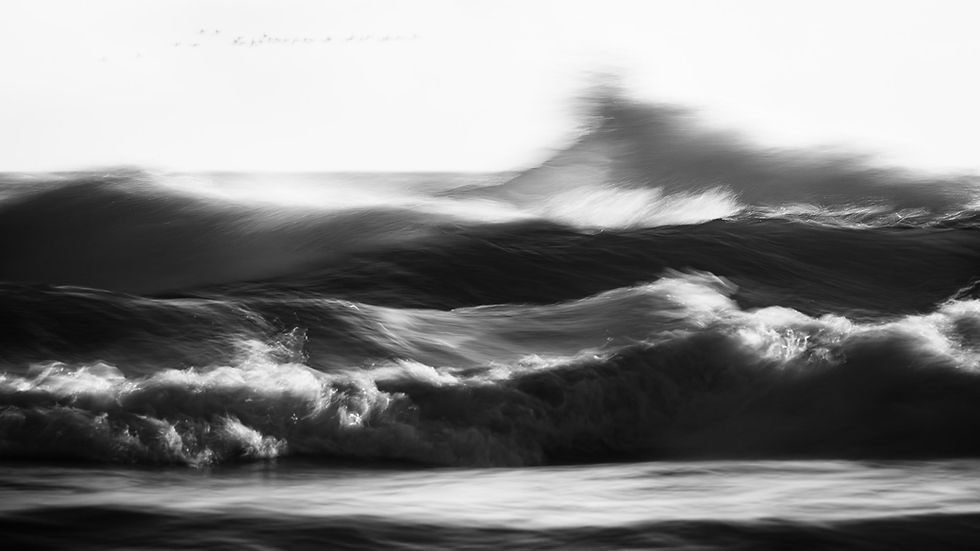
Intentional camera movement, in-camera multiple exposure, and other techniques can move even farther from literal description while still being clearly photographic. Through the very nature of the abstraction the viewer already understands that the result is an interpretation rather than a neutral record.
That doesn't create a loophole where anything is automatically "honest" because it looks abstract. It simply shows why a single processing rule - or even third-party opinion - rarely fits every kind of image you make.
Audience Trust Matters More Than a Technique Checklist
It's easy for photographers to assume everyone can recognize a sky replacement, exaggerated saturation, stretched peaks, or a composite. We both argue that many non-photographers cannot: a technically experienced viewer may spot the clues quickly, while a casual viewer may simply assume the scene existed exactly as shown.
That asymmetry means open and honest disclosure matters. The issue isn't whether compositing, AI-assisted creation, or heavy manipulation requires skill: tt often does (and often a great amount of skill). Jeffrey explicitly states he's not opposed to those tools as creative media, but his concern is around authenticity. Describe the work in a way that matches what it is.
If you use a photograph as the foundation for digital art, calling it digital art can add context rather than diminish the work. If you move a cloud, replace a sky, or combine frames from different moments, a short note can prevent the viewer from making an assumption you know is inaccurate. This doesn't mean you have to include a formal disclosure statement on every social media post or in your website captions. A simple phrase along the lines of, "This digital creation represents...".
If you're asked by a viewer if the scene is authentic, don't skirt around the truth by providing a vague or, even worse, outright misleading answer. Embrace your creative vision and the time, effort, and skill that went into creating the final image.
Authenticity isn't a ban on compositing, AI, or heavy editing. It's being honest about what you made.
Your Business Context Can Raise the Stakes
The consequences become more significant if your photography is tied to a product or service. A print buyer may care whether a photograph represents a real place and moment; a workshop participant may reasonably expect that the images used to market the workshop reflect techniques they can actually learn in a location that actually exists; a competition may have its own rules for compositing, object removal, generative tools, or RAW verification.
You don't need to make every personal experiment comply with the strictest possible standard. You do need to understand the context in which the image will be judged. The same composite can be perfectly appropriate in a digital-art portfolio and misleading on a page advertising a representational landscape workshop if the distinction is left unexplained.
Write a Personal Ethics Statement Before You Need One
A personal ethics statement doesn't need to be a public manifesto but it can help you frame your own position on this topic. It can be a few sentences in your notes (written or even simply mental) that describe what you're comfortable doing and how you'll talk about it. Jeffrey likes the idea because it gives you an anchor before you are staring at a specific file and rationalizing a choice after the fact.
Your statement might say that you will remove temporary distractions but not permanent natural features. It might allow sky replacement as long as it is disclosed, or it might distinguish between documentary projects and personal art. It might say that anything created with or significantly altered by generative AI will be labeled as digital art. It might also change as your personal feelings and your work change over time.
The point is not to make your rules match somebody else's: the point is to know what your rules are, why they exist, and when a different creative project deserves a different set of expectations.
Your personal ethics statement does not need to match ours. It needs to match the work you are willing to stand behind.
Experiment Before You Decide What Your Style Is
Neither of us recommends deciding your identity as a photographer before you've tried the alternatives. Jeffrey has experimented with sky replacement even though it's not part of the work he normally publishes. We've both pushed edits harder in the past and learned from seeing where the subsequent results stopped feeling right to our own internal compasses.
That past experimentation was valuable for us as creative boundaries are easier to understand after you've crossed them on purpose. Try the ICM. Try a multiple exposure. Try the dramatic black-and-white conversion. Try building a composite. Try an edit that is more restrained than your normal style. You may discover that something you assumed you would dislike actually unlocks a new aspect of creative vision, or you may confirm exactly why it doesn't fit your work and personal preferences.
The experiment does not have to become part of your portfolio. Its value may simply be helping you recognize your own stance on this topic with more confidence.
Put It Into Practice: Edit One Photograph Three Ways
Use one RAW file from a scene you remember clearly. Make three virtual copies and treat each version as a different creative brief.
✓ Version 1: Stay representational. Adjust exposure, white balance, contrast, color, and local tone only as much as needed to communicate the scene as you remember experiencing it.
✓ Version 2: Push the interpretation. Use stronger local contrast, more assertive color decisions, deeper dodging and burning, or a black-and-white treatment while keeping the actual scene elements intact.
✓ Version 3: Remove the guardrails. Try a sky replacement, object movement, compositing, generative fill, or another technique you would not normally use. This version is an experiment, not a requirement to publish it.
✓ Write one sentence of disclosure for each version. If the sentence feels awkward or evasive, ask what that discomfort is telling you about the edit.
✓ Compare the three images without ranking them only by visual impact. Which one feels most like your photographic voice?
✓ Draft a two- or three-sentence personal ethics statement based on the choices that felt right. Revisit it after more field and editing experience.
The point isn't to prove that one approach is morally superior to the others. It's to understand which version asks the viewer to believe what you actually want your work to say.
Listen to Our In-Depth Discussion
Episode 37 of our Shutter Nonsense podcast adds the personal side of this topic: how our editing styles have changed, why Michael now solves more problems in the field, why Jeffrey keeps returning to Lindy Point instead of "cheating" with a sky replacement, where abstracts and black-and-white work change our own guardrails, and why we both think experimentation is necessary before you can define your line.
If you found this article valuable, let us know by tapping the heart icon below!


